For financial institutions operating in digital assets, 1099-DA is no longer a future regulatory requirement, but an operational reality.
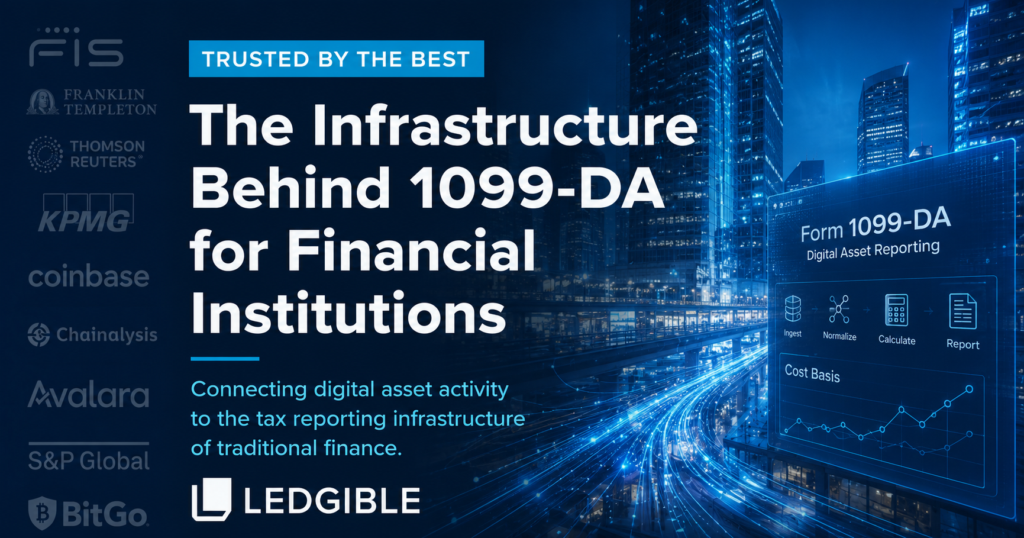
The first phase of Form 1099-DA brought digital asset gross proceeds into a dedicated information reporting framework. Now, as the industry moves deeper into cost basis reporting, institutions face a considerably larger challenge: connecting fragmented digital asset activity to the established tax reporting infrastructure of traditional finance.
That challenge is about much more than generating a tax form.
It requires institutions to ingest data from systems that were never designed for traditional tax reporting, normalize transactions across assets and platforms, calculate and maintain cost basis, reconcile activity, apply evolving reporting rules, and ultimately deliver accurate information into established tax workflows.
This is the infrastructure problem Ledgible was built to solve.
1099-DA Changes the Digital Asset Operating Model
The arrival of 1099-DA represents an important transition for digital assets.
For years, institutions could approach digital asset tax reporting through specialized processes that existed alongside traditional financial reporting infrastructure.
That separation is becoming increasingly difficult to maintain.
As we recently explored in 1099-DA Is No Longer a Tax Project — It’s Financial Infrastructure, the form itself is ultimately the output of a much larger data challenge.
Financial institutions need to understand what happened, when it happened, which asset was involved, who owned it, how it was acquired, and how the transaction should ultimately be treated for reporting purposes.
With digital assets, those answers can be distributed across exchanges, custodians, internal ledgers, wallets, blockchains, and other systems.
The ability to connect those systems is quickly becoming a prerequisite for operating digital asset products at institutional scale.
Cost Basis Is Where the Complexity Accelerates
Gross proceeds were an important first step.
Cost basis is where many institutions will begin to experience the full operational complexity of digital asset reporting.
Unlike a traditional financial asset operating within relatively standardized infrastructure, a digital asset can move between wallets, platforms, and custodians. It can be exchanged for another digital asset rather than cash. Transaction data can originate on-chain or within private ledgers. And the information required to establish the history of an asset may not reside within a single system.
That is why Ledgible has spent years building infrastructure specifically around the complexities of digital asset cost basis reporting.
Ledgible's platform ingests digital asset transaction data, normalizes that activity into a consistent data model, and applies the calculations and reporting logic institutions need to connect digital asset activity with their existing tax information reporting workflows.
That distinction matters.
Financial institutions do not need another isolated crypto system.
They need digital assets to work within the systems they already trust.
Connecting Digital Assets to Established Financial Infrastructure
That philosophy has shaped how Ledgible works across the financial ecosystem.
Through our work with Thomson Reuters ONESOURCE, Ledgible enables enterprises and institutions to aggregate, normalize, categorize, and calculate digital asset cost basis data for established tax information and compliance reporting processes.
Our partnership with Avalara similarly brings digital asset cost basis capabilities into broader 1099 reporting operations.
These relationships represent something larger than individual integrations.
They reflect how institutional digital asset infrastructure is evolving.
Rather than replacing the financial technology ecosystem institutions have spent decades building, digital asset infrastructure increasingly needs to connect to it.
Ledgible provides that bridge.
Built for the Complexity Behind the Form
The simplicity of a 1099 can obscure the complexity required to produce it.
Before a form reaches a customer, institutions may need to aggregate transaction activity, identify reportable dispositions, distinguish between transaction types, establish asset histories, calculate basis, reconcile exceptions, and preserve an auditable record of how reported information was produced.
At scale, spreadsheets and manual reconciliation quickly become operational liabilities.
As we discussed in Digital Asset Tax Reporting Is Becoming an Enterprise Data Problem, one of the most useful measures of reporting maturity is how frequently people must intervene in the process.
Every manual transformation creates friction.
Every disconnected dataset creates another reconciliation requirement.
Every reporting decision that exists outside the core infrastructure creates another potential point of failure.
Ledgible was purpose-built to reduce that complexity by creating a standardized data and calculation layer between digital asset activity and enterprise financial systems.
Experience Matters When Regulation Becomes Reality
1099-DA may feel new to much of the financial industry.
The underlying problems are not new to Ledgible.
For years, Ledgible has worked at the intersection of digital asset data, tax, accounting, and financial reporting. That experience has included working alongside some of the institutions shaping the future of digital finance.
As we highlighted in The Institutions Building Digital Finance Trust Ledgible, our collaborations and integrations have included organizations across financial infrastructure, banking, asset management, tax technology, and digital assets.
That ecosystem matters because 1099-DA does not exist in isolation.
It sits at the convergence of digital asset infrastructure and the traditional financial system.
Understanding both sides of that equation is increasingly important.
Reporting Is Also a Customer Experience
There is another reason institutions need to get this infrastructure right.
Customers experience the results.
A tax form is one of the few moments when the enormous complexity of an institution's back-office infrastructure becomes directly visible to an individual investor.
If the information is accurate and understandable, very little happens.
If it is not, the customer calls.
As we explored in The Hidden Risk in 1099-DA Is the Customer Experience, reporting quality therefore has consequences beyond regulatory compliance.
It affects customer support, correction volumes, operational costs, and ultimately trust.
For institutions building digital asset businesses, the ability to explain how reported information was produced is nearly as important as producing it in the first place.
That requires infrastructure designed for traceability and auditability from the beginning.
Building Beyond the Next Filing Deadline
There will always be another reporting deadline.
The institutions leading digital asset adoption are increasingly looking beyond them.
The more strategic question is whether the infrastructure being built for 1099-DA can support what comes next.
Can it accommodate increasing transaction volumes?
Can it support new digital assets and transaction types?
Can it connect with existing enterprise tax technology?
Can it adapt as reporting requirements evolve?
And can the same normalized digital asset data support additional tax, accounting, reconciliation, and compliance use cases across the institution?
As we wrote in The Competitive Advantage in Digital Assets May Be Operational Readiness, the institutions that succeed in digital assets may ultimately be distinguished less by their ability to launch digital asset products than by their ability to operate them reliably at scale.
1099-DA is an important test of that capability.
The Infrastructure Is Already Here
The digital asset industry does not need to build an entirely separate financial system to meet the demands of institutional adoption.
It needs infrastructure capable of connecting digital assets to the financial system that already exists.
That is the role Ledgible continues to build.
From digital asset data aggregation and normalization to cost basis calculation and tax information reporting, Ledgible provides the infrastructure institutions need to turn complex digital asset activity into information traditional financial systems can understand and use.
1099-DA may be the immediate requirement.
But the opportunity is considerably larger.
As digital assets become an increasingly ordinary part of global finance, institutions will need infrastructure that makes their underlying complexity ordinary, too.