Over the past several years, the conversation around digital assets has matured considerably.
Not long ago, most discussions centered on the potential of blockchain technology and the possibilities it might unlock. Today, those conversations look very different. The industry's largest financial institutions are no longer asking whether digital assets will play a role in the future of finance. Instead, they are grappling with a far more practical challenge: how to incorporate these new asset classes into the systems, processes, and regulatory frameworks that already govern global markets.
For all of the innovation that has occurred within digital assets, success increasingly depends on something far less glamorous than tokenization, stablecoins, or blockchain infrastructure. It depends on integration.
From Digital Assets to Financial Infrastructure
The institutions leading this transition are discovering that bringing digital assets into production environments requires more than access to blockchain networks. It requires the ability to reconcile activity across multiple systems, satisfy evolving regulatory obligations, and create a consistent operational framework that can support both traditional and digital assets simultaneously.
That challenge was articulated particularly well by Andrés Choussy, President of Capital Markets at FIS, who noted that the greatest opportunity lies with firms capable of "straddling the line between digital and traditional assets" while bringing the trust and security expected within established financial markets.
It's a challenge that resonates across nearly every segment of the industry.

Whether the conversation involves banks exploring digital asset services, asset managers launching tokenized products, or financial infrastructure providers connecting new technologies to existing workflows, the underlying objective remains remarkably consistent: create a seamless experience for clients without requiring them to choose between traditional finance and digital finance.
Discussing the partnership between FIS and Ledgible, Choussy explained that Ledgible is helping FIS "get access to all the digital markets and bring them together along with traditional assets in a way that is holistic and meets the needs and expectations of each institutional client."
Making Blockchain Data Useful
That idea of bringing everything together has become increasingly important as digital asset activity expands beyond a single blockchain, custodian, or use case.
Consider the challenge facing a global asset manager operating across multiple chains. The data itself may exist, but turning that information into something usable for accounting, reporting, tax operations, and regulatory compliance is an entirely different exercise. Transactions occurring across separate blockchain ecosystems must ultimately be normalized, reconciled, and translated into formats that align with existing financial systems.
That reality was a key factor behind Franklin Templeton's decision to partner with Ledgible. As the firm expanded its digital asset initiatives, it required a solution capable of integrating data across multiple blockchains while supporting dynamic tax calculations, reconciliation with legacy systems, Forms 1099 and 1042-S reporting, and a growing set of financial reporting requirements.
In many ways, Franklin Templeton's experience reflects what is happening across the broader market. The challenge is no longer obtaining blockchain data. The challenge is transforming that data into trusted financial information.
Preparing for a New Era of Reporting
At the same time, regulatory expectations continue to evolve.
As new digital asset reporting requirements emerge around the world, firms are being asked to solve increasingly complex cost basis and information reporting challenges. Activities that may appear straightforward on the surface often become significantly more complicated when digital assets are acquired through swaps, transfers, staking activity, or other blockchain-native transactions.
Speaking about Avalara's partnership with Ledgible, General Manager Kael Kelly highlighted exactly this issue, noting that new IRS requirements introduce a unique level of complexity for digital asset cost basis reporting, particularly when assets are acquired not only through cash purchases but through exchanges involving other digital assets.
For Kelly, the objective of the partnership is clear: simplify digital asset reporting and compliance, reduce friction, improve efficiency, and give customers greater control over their reporting obligations.
Scaling Compliance for Institutional Adoption
Those same themes have surfaced repeatedly in conversations throughout the tax and reporting ecosystem.
Organizations preparing for Form 1099-DA and other emerging reporting frameworks are increasingly focused on finding solutions that reduce operational burden while ensuring readiness for future regulatory changes.
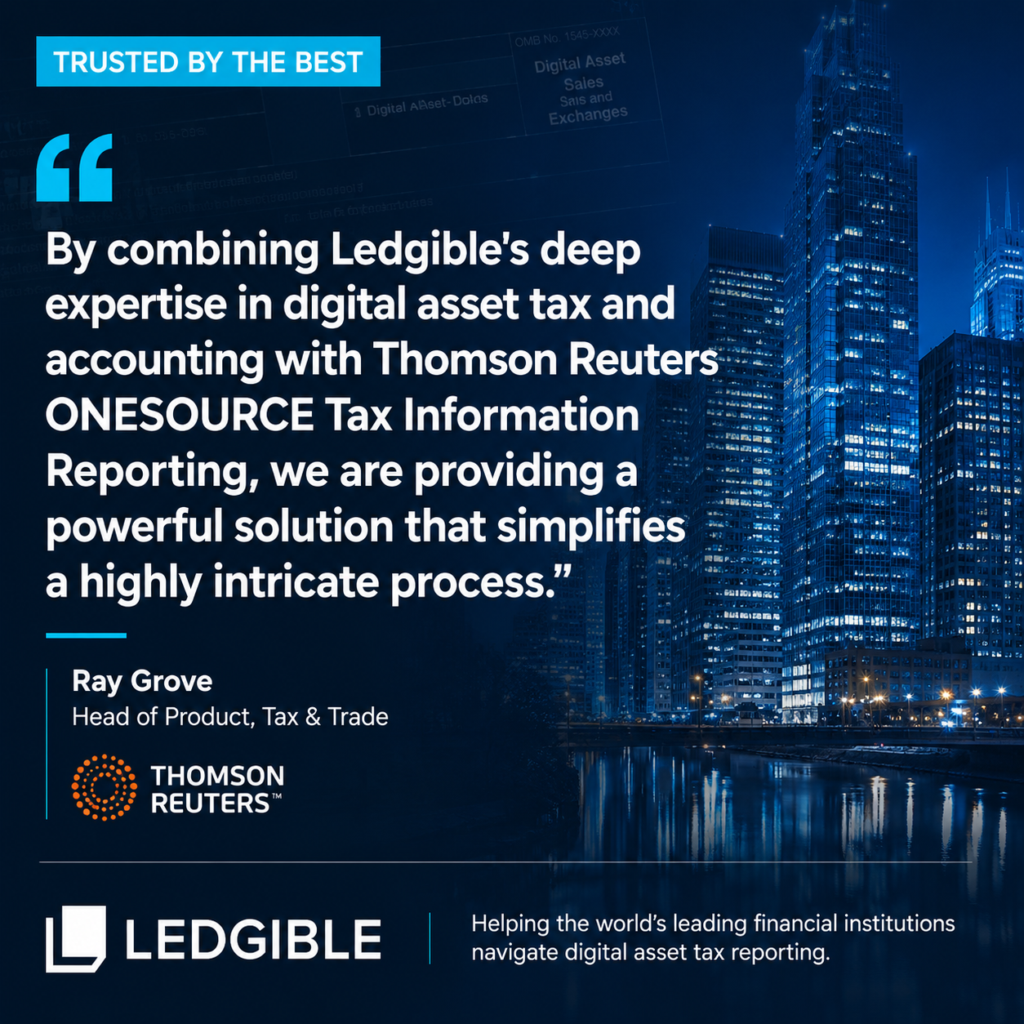
As Ray Grove, Head of Product, Tax and Trade at Thomson Reuters, observed, the rapid evolution of the digital asset landscape has created demand for robust and reliable solutions capable of navigating an increasingly complex compliance environment.
Discussing the partnership between Thomson Reuters and Ledgible, Grove pointed to the combination of Ledgible's expertise in digital asset tax and accounting with Thomson Reuters ONESOURCE Tax Information Reporting as a way to simplify what is often an extraordinarily intricate process while helping organizations minimize risk and prepare for new reporting requirements.
Taken together, these partnerships tell a larger story about where the industry is heading.
The future of digital finance is not being built in isolation from the existing financial system. It is being built through the deliberate integration of new technologies into institutions that already operate at enormous scale and under significant regulatory scrutiny.
The organizations leading this transformation understand that innovation alone is rarely enough. New technologies ultimately succeed when they can be incorporated into existing business processes, satisfy compliance obligations, and create confidence among clients, regulators, and stakeholders alike.
From financial infrastructure providers and global asset managers to tax and reporting leaders, the institutions helping shape the future of digital finance are solving many of the same challenges. They are working to connect digital assets with the systems that power modern finance.
Ledgible is proud to be helping them do exactly that.
About Ledgible
Ledgible is the enterprise digital asset tax, accounting, and data-reporting platform built for institutions, exchanges, custodians, and service providers. Ledgible transforms blockchain-native data into clear, compliant, and auditable records, enabling institutions to meet regulatory and reporting obligations while scaling digital asset operations with confidence.
Contact
Jan Jahosky
Jan@ledgible.io